
About Genes

Genes, DNA, and chromosomes

Genes are like the instructions you inherit from your parents.

They carry the information that makes each person unique — your eye color, height, or how your body works inside.

Most genes tell the body how to make proteins, which are like the building blocks or tools that keep everything running properly — from muscles to the brain. In total, humans have about 20,000 protein-coding genes.

Genes are made of a molecule called DNA. You can think of DNA as a very long text written with just four letters: A, C, T, and G. These letters combine in different orders to form the “words” that give your body its instructions.

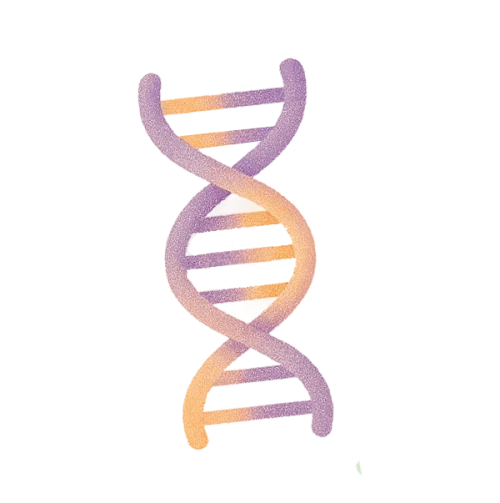
DNA has a double-helix shape, which looks like a twisted ladder. Each rung connects two letters: A always pairs with T, and G always pairs with C.
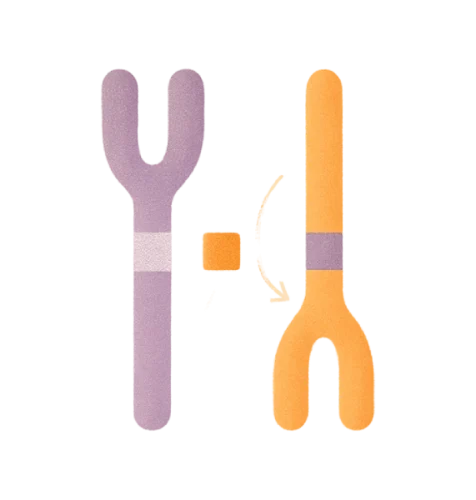
Even though DNA strands are incredibly long, they fit inside our tiny cells because the DNA is tightly packed and organized into structures called chromosomes.
In short:

Chromosomes hold the DNA, DNA contains the genes, and genes are the manual that makes each of us who we are.

20,000

protein-coding genes

Single Gene Disorders

Sometimes, a single gene can change and cause a health condition.
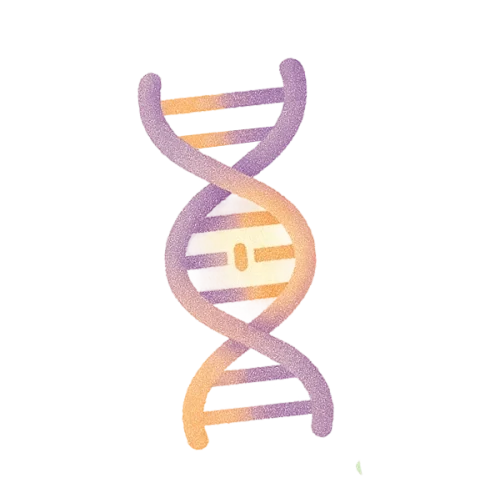
This happens when a small part of its sequence —one or more of the DNA “letters” G, A, T, or C— is altered in a way that affects how the body works.

This kind of change is called a genetic variant. When a variant leads to a health or developmental problem, it’s known as pathogenic, meaning it causes disease.

But not all variants are harmful. In fact, we all carry millions of them in our DNA.

They appear naturally, as tiny “errors” that occur when our cells divide and copy their chromosomes. Scientists estimate that each person has around 3 to 4 million DNA variants that have accumulated over time through evolution. Most have little or no effect —these are benign variants.

Each child is also born with about 75 new variants that weren’t inherited from either parent. These small changes are part of what makes every human being unique.

75

new variants in every child

De novo variants

When a genetic variant is described as de novo, it means it appeared as a new change in the child and is not found in either parent.
This is confirmed by testing the parents’ DNA and seeing that neither carries the same genetic change as their child.

De novo variants arise naturally, usually in the egg or sperm before conception. Every child has many of them, and most are benign, meaning they don’t cause any problem, because they don’t affect how important genes work.

However, if one of these de novo variants disrupts a key gene involved in growth or health, it can lead to a genetic condition.

In few words, a de novo variant is not inherited, but rather appears for the first time in the child, as part of life’s natural genetic diversity.

Inherited Variants

Some single-gene variants can be inherited from parents who have no symptoms or who are only mildly affected.
The severity of the symptoms determines whether a person can have children and pass the altered gene on to the next generation.

Another common word for a “variant” is mutation.
Nowadays, many experts prefer to say variant instead of mutation, because not all mutations are harmful —some have no effect at all and are simply part of the natural diversity in our DNA.

Sox6
Privacy Overview

This website uses cookies so that we can provide you with the best user experience possible. Cookie information is stored in your browser and performs functions such as recognising you when you return to our website and helping our team to understand which sections of the website you find most interesting and useful.